
1-Second Haemostasis: The Future of Emergency Haemorrhage Control
1-Second Haemostasis: The Future of Emergency Haemorrhage Control
In trauma management, the phrase "time is tissue" is a mantra. When dealing with life-threatening haemorrhage, seconds often dictate the difference between a survival outcome and a preventable mortality.
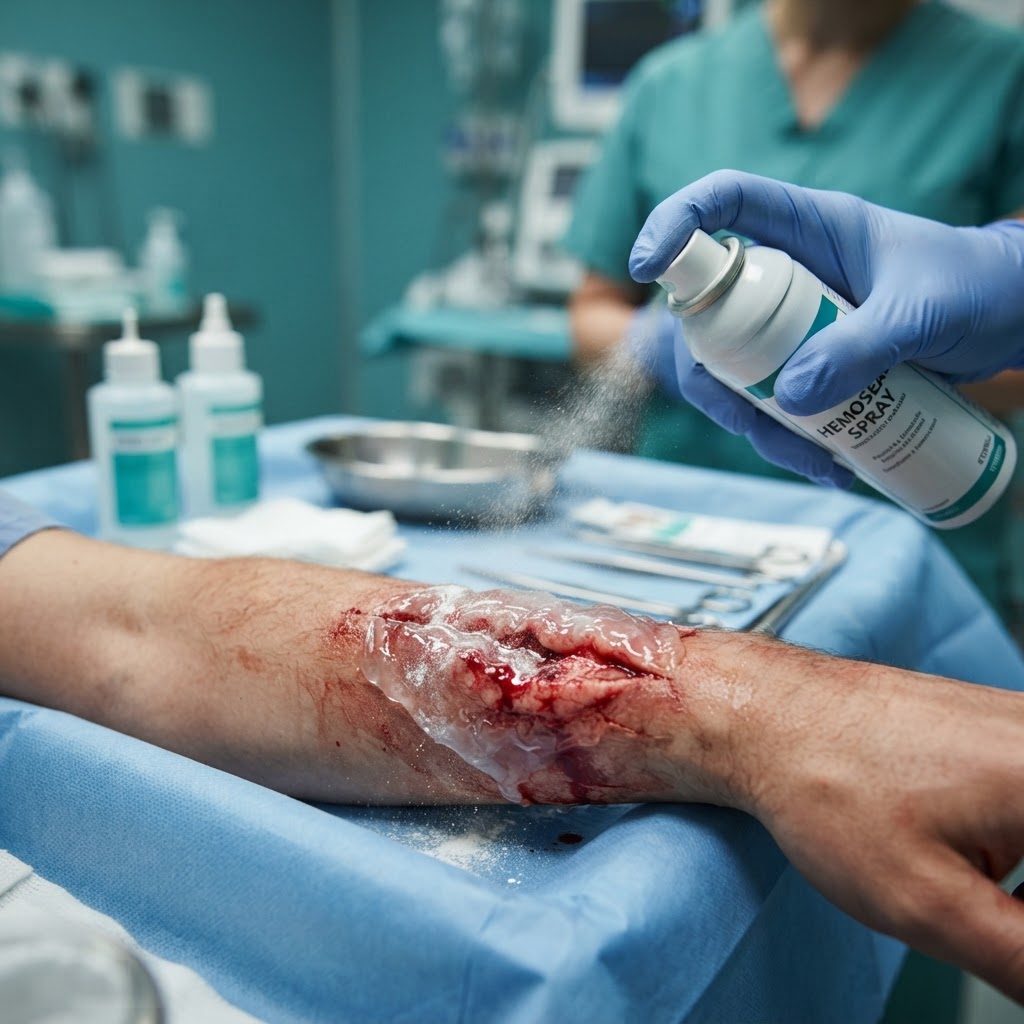
New research from KAIST, published in Advanced Functional Materials (2025), has introduced a revolutionary "spray-on" powder — AGCL powder — that promises to stop severe bleeding in just one second. As clinicians and trainers, it is essential we look past the headline to understand the clinical efficacy and potential application of these next-generation haemostatic agents.
The Clinical Challenge: Beyond the Patch
Traditional patch-type haemostatic agents are mainstays in our kits, but they suffer from significant limitations:
- Geometry Constraints: They struggle to conform to deep, jagged, or irregular wound beds common in high-energy trauma.
- Storage Sensitivity: Many are susceptible to temperature and humidity fluctuations, which is problematic for field kits kept in vehicle ambulances or tactical environments.
The AGCL Breakthrough: How It Works
The AGCL (Alginate-Gellan Gum-Chitosan-based) powder represents a shift from passive absorption to active ionic reaction.
- Ultra-fast Gelation: Upon contact with blood cations (specifically calcium), the powder transitions into a stable, robust hydrogel in approximately one second.
- Conformity: Unlike a flat dressing, the powder fills the irregular voids of a complex wound, creating a 3D physical seal.
- High Absorbency: It can absorb over seven times its weight in blood (725%), maintaining a firm barrier even under the high-pressure conditions of arterial or deep venous bleeding.
Clinical Safety and Efficacy
From a compliance and safety perspective, the data is encouraging. With 99.9% antibacterial efficacy and near-perfect cell viability, the material bridges the gap between effective trauma sealing and biological safety. In surgical models, it not only accelerated the cessation of bleeding but also supported better vascular and collagen regeneration post-application.
Implications for Emergency Management
While this technology was engineered with battlefield conditions in mind, the implications for civilian pre-hospital care are significant:
- Disaster Response: The long-term storage stability (two years at room temperature and high humidity) makes it an ideal candidate for mass-casualty kits.
- Deep Wound Management: It offers a more versatile solution than standard packing gauze for complex, deep trauma.
- Integration into Training: As these technologies move from defence to civilian use, we must evaluate how they integrate into our First Aid at Work (FAW) and haemorrhage control curricula.
Professional Reflection (CPD)
As educators, how do we update our training to incorporate these advances?
- Reflective Question: If a new haemostatic agent reduces "time to seal" from minutes to seconds, does this change how we teach "wound packing" versus "topical application"?
- Compliance Note: Always remember that technological aids are a supplement to, not a replacement for, core clinical skills. Our training must continue to focus on fundamental principles: direct pressure, tourniquet application, and controlled packing.
Guardian Medical remains committed to monitoring these advancements. We will continue to evaluate AGCL-style technologies for potential inclusion in our high-risk clinical training kits.
Source: KAIST. "This spray-on powder can stop life-threatening bleeding in 1 second." ScienceDaily, 2 July 2026. Son, Y., Park, K. et al. "An Ionic Gelation Powder for Ultrafast Haemostasis and Accelerated Wound Healing." Advanced Functional Materials, 2025; 36(22).